
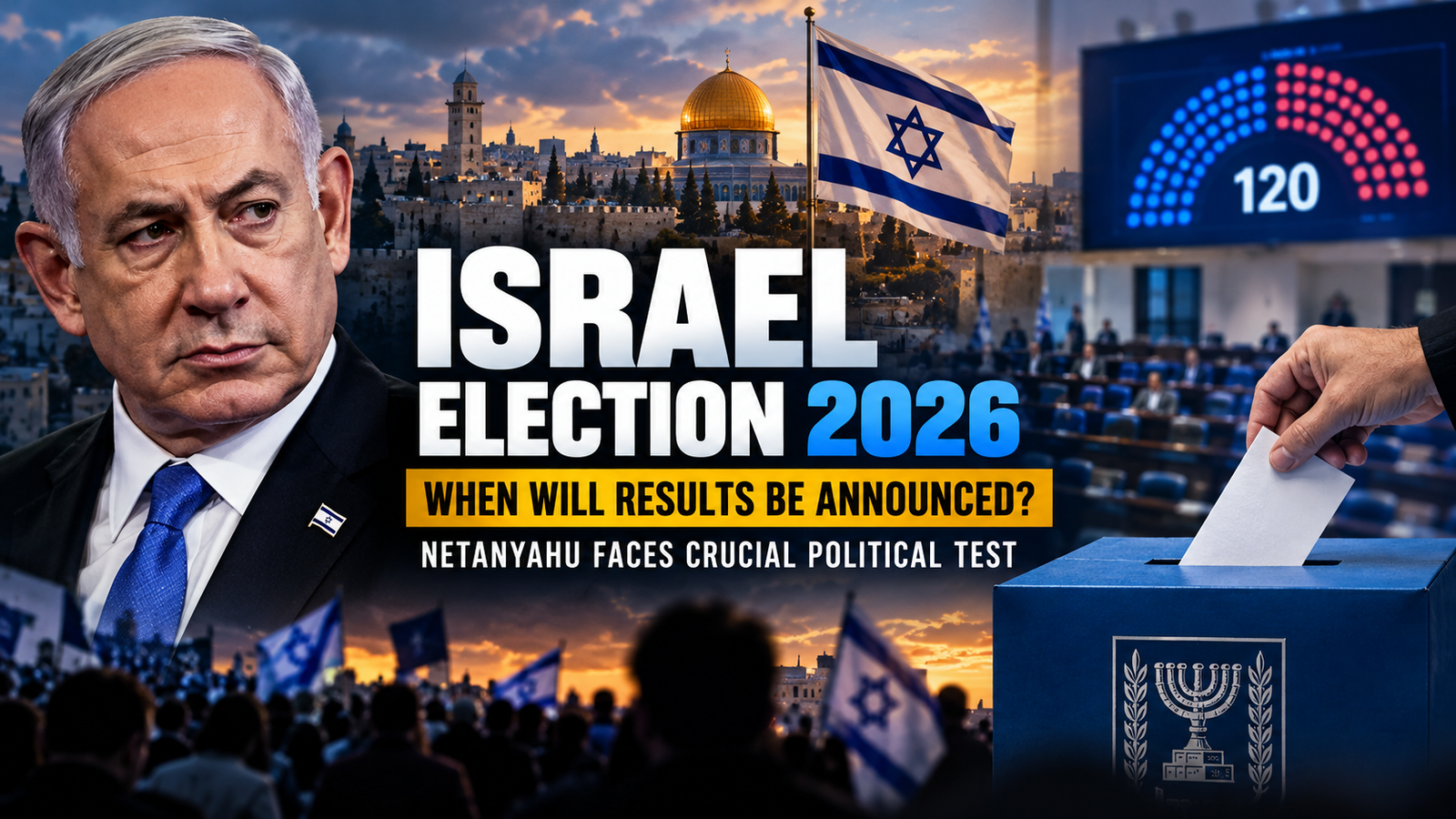
Jerusalem, October 27, 2026: Israel is voting in a closely watched parliamentary election that could reshape the country’s political leadership, with Prime Minister Benjamin Netanyahu facing a major challenge from opposition parties. Initial indications are expected after polling stations close, but the final outcome and the formation of a new government could take considerably longer.
The election is the first since the Hamas-led attacks of October 7, 2023, and the subsequent war in Gaza. It comes amid continuing security concerns, domestic political divisions and mounting international scrutiny of Israel’s policies. Source: Al Jazeera
When Will Israel Election Results Be Announced?
Voting began at 7 am local time on Tuesday and is scheduled to end at 10 pm. Israeli television channels are expected to release exit polls shortly after polling stations close, providing the first indication of which political blocs may have performed best.
However, exit polls are estimates rather than official results. The counting process and the allocation of parliamentary seats will determine the actual strength of each party and its potential partners.
According to Reuters, the final vote tally is expected by October 30, while the official results are scheduled for publication by November 4. The political outcome could remain uncertain for days or longer if competing blocs struggle to secure enough support to form a government.
Netanyahu’s Leadership Faces a Defining Test
Benjamin Netanyahu’s political future is one of the central questions surrounding the election. His government has faced criticism over security failures preceding the October 7 attacks, its handling of the war and hostage negotiations, allegations of corruption, and disagreements over military service exemptions for ultra-Orthodox Jewish men.
The opposition is seeking to turn public dissatisfaction into a parliamentary majority. Former Israeli military chief Gadi Eisenkot is among the principal opposition figures challenging Netanyahu’s political bloc.
Pre-election polling cited by Al Jazeera suggested a close contest. An average of polls from Israeli television channels projected approximately 50 seats for Netanyahu’s bloc and 54 for the opposition bloc led by Eisenkot. These were projections published before voting, not confirmed election results.
Why Are 61 Seats So Important?
Israel’s parliament, known as the Knesset, has 120 seats. A governing coalition generally needs the support of at least 61 lawmakers to command a parliamentary majority.
Israel uses a proportional representation system in which voters choose party lists rather than directly electing the prime minister. Parties that win enough votes receive parliamentary seats, and political leaders then negotiate to assemble a governing coalition.
This system means that winning the largest number of seats does not automatically guarantee the right to govern. Smaller parties can become decisive partners when larger blocs fall short of a majority.
Parties must also cross the national electoral threshold of 3.25 percent to qualify for parliamentary representation. With numerous parties competing, the final distribution of seats may take time to establish.
What Happens After the Election Results?
Once the official results are published, Israel’s President Isaac Herzog is expected to consult political parties and assess which candidate has the best chance of forming a government.
The nominee will then attempt to build a coalition capable of securing parliamentary confidence. Under the reported timetable, the candidate can have up to 42 days to complete the process.
If the first nominee cannot form a government, another candidate may be given an opportunity. If coalition negotiations ultimately fail, Israel could face another election, while the outgoing government remains in a caretaker capacity.
The process means that election night may reveal the broad political direction without immediately settling who will become prime minister.
Gaza and Regional Security Remain Major Concerns
The election is taking place against the backdrop of the devastating war in Gaza and wider regional tensions. The outcome will be closely watched by Palestinians, neighbouring countries and international partners concerned about Israel’s future security and foreign policy.
For Palestinians in Gaza, the political transition raises questions about humanitarian access, restrictions, displacement, reconstruction and the prospects for lasting peace. Netanyahu’s opponents have criticised aspects of his government’s policies, although a change in leadership would not automatically guarantee a major shift in policy towards Palestinians.
The next Israeli government will also face pressure to address domestic security concerns, manage relations with the United States and other international partners, and respond to criticism over the country’s conduct during the war.
What Does This Election Mean for Israel’s Future?
The result will be important not only for Netanyahu’s political survival but also for the direction of Israel’s domestic and international policies.
A strong performance by Netanyahu’s bloc could allow him to seek another coalition with existing political partners. A stronger opposition showing could increase the possibility of a change in leadership, provided its parties can agree on a workable governing arrangement.
Neither scenario is guaranteed until the votes are counted and coalition negotiations advance.
The key takeaway: Israel’s election results may begin emerging within hours of the polls closing, but the decisive question is whether any political bloc can assemble the 61 seats needed to govern. Until that becomes clear, Netanyahu’s political future and the direction of Israel’s next government remain uncertain.
This report reflects information available on October 27, 2026. Seat projections are pre-election estimates, not official results.
Sources: Al Jazeera | Reuters | Associated Press


Leave a Reply