
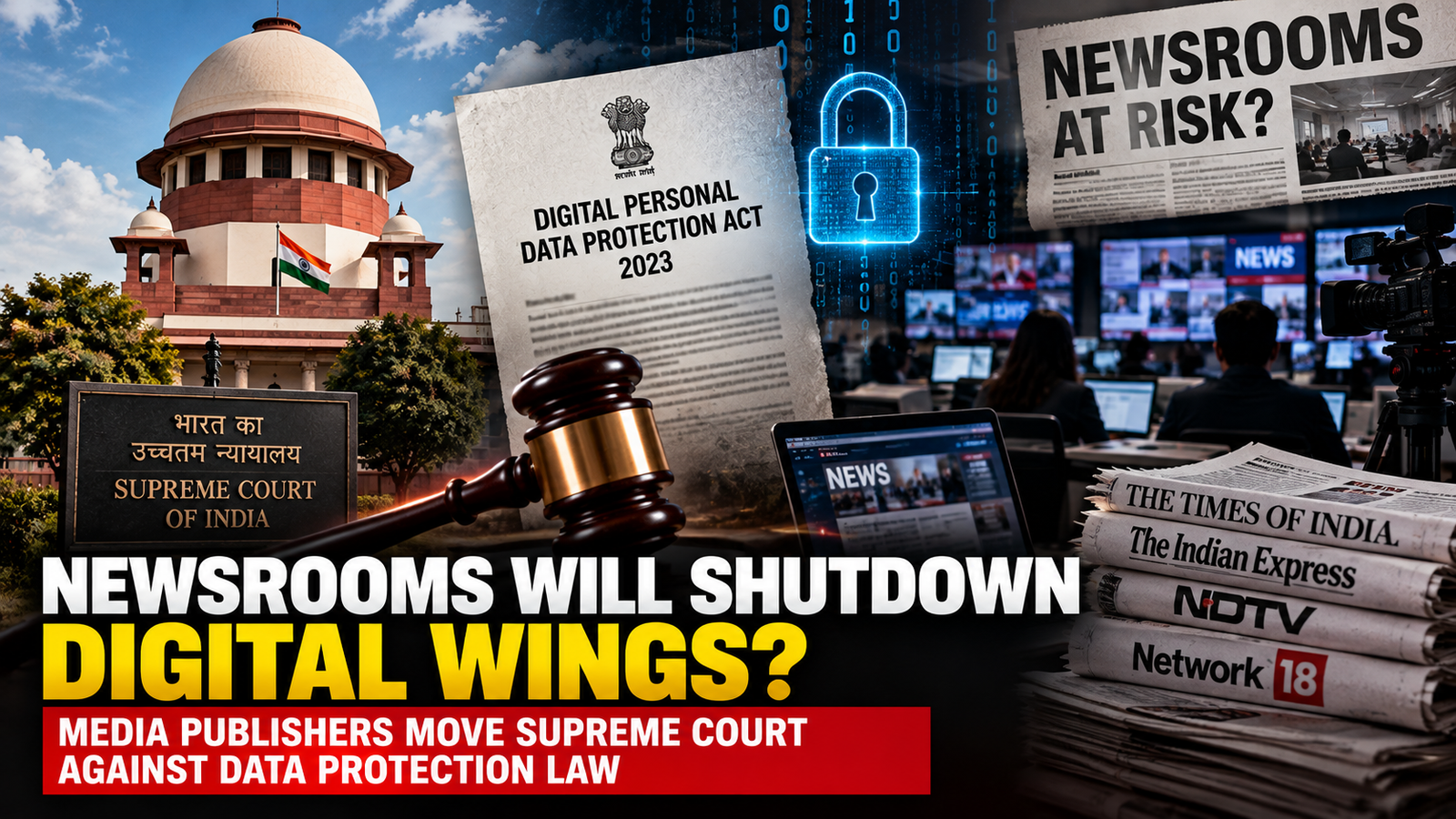
New Delhi, October 27, 2026: India’s digital news industry is facing a significant legal debate over the future of investigative journalism, data privacy and press freedom. The Digital News Publishers Association (DNPA), representing 21 news publishers, has challenged provisions of the Digital Personal Data Protection (DPDP) Act, 2023, and the accompanying DPDP Rules, 2025, before the Supreme Court of India.
The association argues that the law, in its current form, could make certain forms of investigative reporting difficult, expose confidential journalistic sources and force publishers to reconsider how they collect, process and retain personal information.
On October 27, the Supreme Court issued notice to the Union government on the challenge. However, it did not grant the requested interim stay at this stage. The matter is scheduled for further hearing on November 17, 2026. The court has emphasised the need to balance citizens’ privacy rights with the media’s ability to investigate and report matters of public interest.
The case could have important implications for India’s traditional news organisations, digital-first publishers, independent journalists and the wider online information ecosystem.
What Is the DPDP Act, 2023?
The Digital Personal Data Protection Act, 2023, is India’s legislative framework for regulating the processing of digital personal data. Its purpose is to protect individuals against the misuse of their personal information while establishing responsibilities for organisations that collect and process such data.
The legislation introduces obligations concerning consent, transparency, data security and individuals’ rights over their personal information. Organisations covered by the framework may also face enforcement action and financial penalties for non-compliance.
The DPDP Rules, 2025, provide additional details on how the law is to be implemented.
For businesses, technology companies and digital platforms, these requirements form part of a broader shift towards responsible data management.
However, the application of data protection rules to journalism raises a distinct question: how can reporters investigate wrongdoing when the information they need concerns the very individuals or institutions they are investigating?
That is one of the central issues now before the Supreme Court.
Why Have 21 News Publishers Approached the Supreme Court?
The Digital News Publishers Association has argued that the legislation does not provide a sufficiently clear exemption for journalistic activities.
According to the association, applying ordinary data protection requirements to investigative journalism could create practical and constitutional difficulties.
The petition raises concerns about three major areas:
- Consent requirements: Journalists could face difficulties if they are required to notify or seek consent from individuals whose activities are being investigated.
- Data deletion requests: Publishers fear that requests to erase personal information could create pressure to remove or alter factual reporting.
- Confidential sources: Provisions allowing authorities to seek information from organisations could raise questions about the confidentiality of journalistic records and sources.
The association has argued that these requirements could discourage reporting on corruption, corporate misconduct, public administration and other matters of public interest.
Its position is that journalism requires appropriate safeguards because the purpose of an investigation may be to uncover information that powerful individuals or organisations would prefer to keep undisclosed.
These are the petitioners’ arguments, not findings that the Supreme Court has already accepted.
Why Is Consent a Major Concern for Investigative Journalism?
Consent is an important element of personal data protection. It helps individuals understand and exercise control over how their information is used.
However, investigative reporting often operates differently from ordinary commercial data processing.
Consider a hypothetical investigation into suspected financial irregularities involving a public contractor. A reporter may need to examine publicly available records, corporate filings, documents and other relevant information before approaching the people involved.
If the reporter had to notify the subject before examining or using every relevant piece of personal data, the subject could become aware of the investigation before the evidence had been verified.
In certain cases, publishers argue, this could create opportunities to destroy evidence, influence witnesses or obstruct reporting.
The DNPA contends that the absence of a clear journalistic exemption could make some investigations significantly more difficult.
The opposing consideration is equally important: the label of journalism should not become a blanket justification for exposing private information that has no legitimate public-interest value.
The legal challenge therefore raises a question of how privacy safeguards can protect individuals without unnecessarily obstructing genuine public-interest reporting.
Could the Law Force Newsrooms to Remove Published Stories?
Another concern raised by the publishers involves data erasure and the withdrawal of consent.
News organisations maintain digital archives containing years of reporting on public officials, businesses, criminal proceedings, elections and significant social events.
These archives serve as an important historical record. They allow readers to understand earlier events, verify statements and follow the development of public controversies.
Publishers fear that applying data protection obligations without suitable journalistic safeguards could create pressure to delete, redact or alter certain reports when individuals object to the continued use of their personal information.
Such requests can involve competing interests.
For example, a person may have a legitimate concern about the unnecessary publication of sensitive personal information. At the same time, a verified report about a matter of public interest may remain relevant long after its original publication.
The question is whether the legal framework provides a workable way to distinguish between these situations.
The Supreme Court’s eventual consideration of the dispute could help clarify the relationship between personal data rights and the preservation of public-interest journalism.
Confidential Sources and Government Access to Information
Investigative journalism frequently depends on information supplied by whistleblowers, employees, witnesses and other confidential sources.
These individuals may provide documents or information about suspected wrongdoing only if they believe their identities and communications will be adequately protected.
The DNPA has raised concerns about provisions empowering the government to seek information from organisations that process personal data. Publishers argue that, without appropriate safeguards, such powers could put confidential sources and sensitive journalistic records at risk.
They also contend that uncertainty surrounding these obligations could discourage potential whistleblowers from approaching news organisations.
This is a significant issue for investigations involving alleged corruption, corporate misconduct or irregularities in public institutions.
However, the precise legal scope of government information requests, the safeguards applicable to them and their application to journalistic records must be assessed under the legislation and the arguments presented before the court.
The case does not establish that every government request will expose a journalist’s source. Rather, it raises questions about the safeguards required to prevent inappropriate disclosure.
What Happened in the Supreme Court on October 27?
A three-judge bench comprising Chief Justice of India Surya Kant and Justices Joymalya Bagchi and V. Mohana heard the DNPA’s challenge.
Senior Advocate Madhavi Divan, appearing for the association, argued that the absence of a journalistic exemption could interfere with the practical functioning of newsrooms.
The court issued notice to the Union government, seeking its response to the petition. It also considered the association’s request for interim relief but did not grant a stay at this stage.
The proceedings highlighted the need to consider both sides of the issue: individuals must be protected against the misuse of their personal information, while journalists must be able to report responsibly on matters of public importance.
The next hearing is scheduled for November 17, 2026.
Importantly, the Supreme Court has not struck down the DPDP Act or ruled that the legislation is unconstitutional. The substantive questions remain under consideration.
Which Media Organisations Could Be Affected?
The DNPA’s challenge represents 21 news publishers, including major media organisations such as Network18, NDTV, The Indian Express and Times Internet.
The broader debate could also be relevant to digital-first newsrooms, investigative journalism platforms and smaller publishers that rely on digital records and online research.
For established publishers, compliance may require additional legal review, internal policies and systems for handling data-related requests.
For smaller news organisations, uncertainty about legal obligations could create a different challenge: limited resources to assess complex compliance requirements while continuing routine reporting.
The final impact will depend on the legislation’s interpretation, the court’s findings and any subsequent changes to the legal framework.
How Does This Case Affect Ordinary Internet Users?
Although much of the debate centres on journalism, the case also concerns the rights of ordinary individuals.
People routinely share personal information through websites, applications, online services and digital subscriptions. Data protection rules are intended to establish responsibilities for organisations that handle this information.
At the same time, the public relies on journalism to investigate issues that affect everyday life, from public spending and corporate accountability to electoral processes and consumer protection.
A legal framework that adequately protects privacy while preserving legitimate investigative reporting would need to address both interests.
The challenge is not simply a contest between journalists and citizens. Individuals benefit from privacy protections, and they also benefit from access to accurate reporting about issues that affect their communities.
The court’s task is to examine how the competing rights and statutory obligations should be reconciled within the Constitution.
What Happens Next?
The next major development is expected at the Supreme Court hearing scheduled for November 17, 2026.
The Union government’s response and the arguments advanced by the parties will help determine how the challenge proceeds.
Several questions remain important:
- Should journalistic activities receive a specific exemption from certain data protection obligations?
- How should consent and deletion requirements apply to verified public-interest reporting?
- What safeguards should govern requests for information that could reveal confidential sources?
- How should the law balance the right to privacy with freedom of speech and expression?
- What protections should apply to digital news archives and investigative records?
The court’s eventual findings may influence how publishers interpret their responsibilities under the DPDP framework. Until then, the claim that newsrooms will be forced to shut down remains a warning raised by the petitioners, not an established outcome.
Conclusion: Can India Protect Privacy Without Weakening Journalism?
India’s DPDP Act represents an important effort to establish safeguards for personal data in a digital economy. But applying data protection rules to journalism raises difficult questions about consent, confidential sources, public records and the long-term preservation of news archives.
The DNPA’s Supreme Court challenge places these questions at the centre of a constitutional debate.
The objective is not to suggest that journalism should operate without accountability or that privacy rights should be disregarded. Rather, the legal framework must be examined to determine whether it can protect individuals while allowing responsible reporting on matters of public interest.
The Supreme Court’s decision to seek the government’s response marks a step in that process, but it is not a final ruling on the law’s validity.
The key takeaway: India’s data protection law is facing a major challenge from 21 news publishers who argue that the absence of a clear journalistic exemption could hinder investigative reporting. The Supreme Court has issued notice to the government but has not stayed the challenged provisions at this stage. The next hearing is scheduled for November 17, 2026.
This article reflects developments reported on October 27, 2026. The legal challenge remains pending, and the publishers’ allegations should not be treated as final judicial findings.
Sources
- LiveLaw: Newsrooms Will Shutdown Digital Wings of Legacy Media? Challenge to Personal Data Protection Law
- Reuters: Why India’s Privacy Law Has Alarmed News Publishers
- Supreme Court Observer: News Publishers Challenge the DPDP Act
- The Indian Express: Supreme Court Issues Notice on Media Groups’ Challenge


Leave a Reply